
Editora Órbita
Para Aprender · PNLD 2027
A new publisher going up against conglomerates that have been in the national textbook programme for decades. Instead of shouting louder, we became the place where teachers solve their actual problem.
Services
Nationwide
Coverage
3
Funnel stages
2
Media channels
3
Measurement sources
The problem nobody was addressing
A primary school teacher in 2026 inherited an uneven class.
There’s a third-grader who still can’t decode text. There’s a child who reads fluently. And there’s the curriculum, moving at its own pace, indifferent to both. The word that became routine in Brazilian public schools is recomposition: catching up what fell behind without stopping what needs to move forward.
No publisher was talking about that.
They were all talking about their own catalogue — approved collection, complete work, teacher’s material. Product communication, at a moment when the teacher is trying to solve Monday morning.
That’s where Editora Órbita’s campaign found its place.
The challenge
Órbita was competing in the 2027 national textbook programme with its “Para Aprender” collection, against publishers who have been in this market forever, with sales teams, track record and relationships built over decades.
And the programme has a structural difficulty nobody gets around: the selection window is short and dated. Outside it, no effort converts. Inside it, everyone is shouting at once.
The campaign couldn’t be a contest of volume. It had to be a contest of usefulness.
Free professional development as the front door
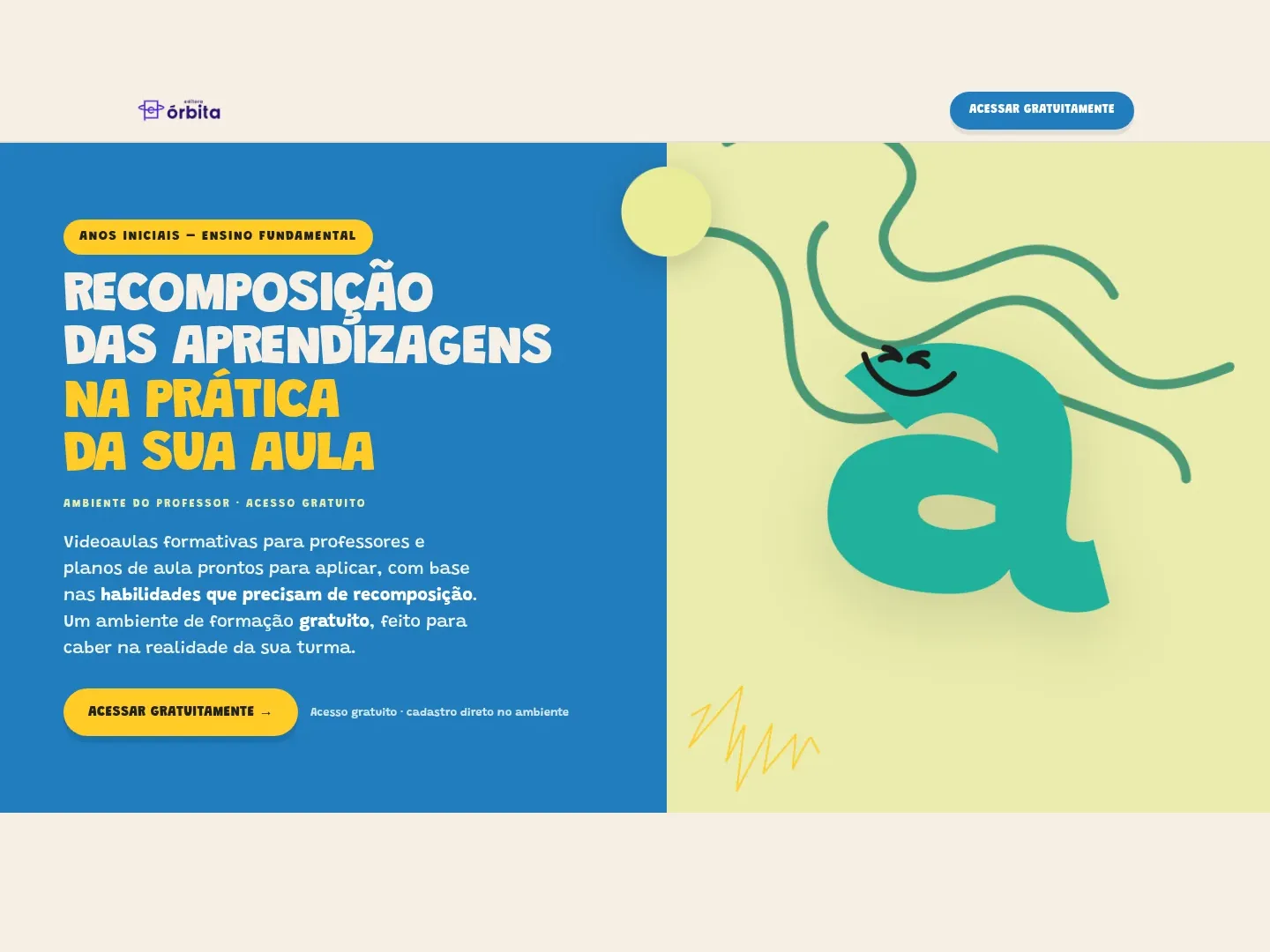
We built the Teacher’s Environment: training videos and ready-to-use lesson plans, organised by the skills that need recomposition. Free access, direct sign-up, no commercial gatekeeper.
It isn’t bait. It’s the material a teacher would look for anyway, delivered by someone who also has a collection to offer.
Deliver value before asking for the choice and you’re no longer competing for attention. You’re competing for trust — and that’s a different game.
The landing page is built around a promise that fits in one line: learning recomposition, in the practice of your own class. No mention of the programme in the headline. Teachers don’t wake up thinking about a government scheme; they wake up thinking about their class.
Everything for planning, in one place
The environment is organised around three things teachers actually do: lesson plans ready to apply, training videos focused on recomposition and assessment, and learning tracks that run through diagnosing, revisiting and advancing — subject by subject, without piling on work.
The collection’s pedagogical logic shows up that way, in use, before any sales argument. The teacher experiences the method in their own classroom.
The best-presented textbook is the one already in use.
Measuring what matters, not what’s easy
The least glamorous and most decisive part: the entire campaign was instrumented to answer one question — how many teachers actually carried the collection’s code into the selection system.
Not impressions. Not clicks. Not visits. The gesture that precedes real adoption.
That took three cross-checked measurement sources, a closed UTM convention with controlled vocabulary, first-party conversion collection on our own server, and a daily read during the selection window. When cost per teacher rises, you can tell within hours whether it’s creative fatigue or end-of-window auction pressure — and the answer changes entirely what you do next.
Across the cycle it produced learnings that outlive the campaign: which channel drives the selection and which drives the sign-up, and that teachers decide at the weekend.
What we built
A free training environment, a campaign identity kit, legal texts that unblocked ad delivery, a documented measurement convention, and a dedicated dashboard where the client follows results without depending on an agency report.
The campaign closed within the cost-per-teacher benchmark agreed in the contract, with a daily read from the first day of the window to the last.
A new collection doesn’t win by being louder. It wins by being more useful, first.
Notes for the nerds
Teacher’s Environment
- Static landing page in Astro, deployed on Vercel
- Free access with direct sign-up, no intermediate commercial step
- Training videos and lesson plans organised by skill
- Its own Terms of Use and Privacy Policy — a delivery requirement on the ad platforms
Measurement
- Three cross-checked sources: cookieless navigation analytics (source of truth), search platform, social platform
- Conversion event defined at the gesture that precedes selection, not at a click or a visit
- UTM convention with closed vocabulary, no free text in
sourceormedium - First-party collection through our own gateway, persisting the raw event before forwarding to platforms
- Campaign dashboard published for the client, updated throughout the window
Media operation
- Structure by funnel stage, with budget and reporting separated per stage
- Daily monitoring during the selection window
- Diagnosis by signal, not intuition: frequency, cost per thousand impressions and click-through rate read together to separate creative fatigue from auction pressure
- Account availability read via API — including blocks that the dashboards report as normal
Project Details
How would you like your story to be told?
Tell us what you have in mind. We listen before proposing anything.
Talk to us